

Key Points:
- Time blindness is a common but often overlooked challenge for individuals with autism, affecting planning and transitions.
- Recognizing the signs of time-related struggles can help parents and caregivers support daily routines more effectively.
- Structured strategies and behavior-based interventions like ABA therapy can significantly reduce the impact of time blindness on daily life.
Many parents of children with autism notice time-related challenges long before they hear the term time blindness. Whether it’s consistently running late, difficulty estimating how long a task will take, or emotional distress when routines are interrupted, these patterns are often more than just bad habits.
According to studies, executive functioning deficits—especially in time perception—are common in up to 80% of autistic youth. This creates a barrier to completing daily activities, managing transitions, and maintaining consistent schedules. Understanding this connection between autism and time blindness is essential for managing these behaviors more constructively.
What Is Autism and Time Blindness?
Autism and time blindness are closely linked through difficulties in executive function, especially time perception and time management. While autism is a neurodevelopmental condition characterized by social, communication, and behavioral differences, time blindness refers to an impaired awareness of time—how it passes, how long tasks take, and how to plan for future events.
These two often intersect, leading to issues with transitions, routines, and independence. Children and teens with autism may struggle to estimate time or to feel the urgency of upcoming deadlines. They might hyperfocus on activities and lose track of the clock entirely.
These challenges aren’t rooted in laziness or defiance; they stem from the brain processing time differently. That’s why the term “time blindness” is not just a metaphor—it reflects a neurological difference that requires practical strategies and tailored interventions.
How Does Time Blindness Affect Children with Autism?
Time blindness can affect nearly every part of a child’s daily life—from getting ready for school to finishing homework. For autistic individuals, this disconnect from time impacts both functional independence and emotional regulation.
Some children might become extremely anxious when asked to switch tasks without warning. Others might consistently underestimate how long something will take, causing delays and frustration.
Over time, these patterns can lead to dependency on adults, missed opportunities to build life skills, and heightened family stress. Understanding the nuances of how time blindness affects your child can lead to better support systems and clearer expectations.
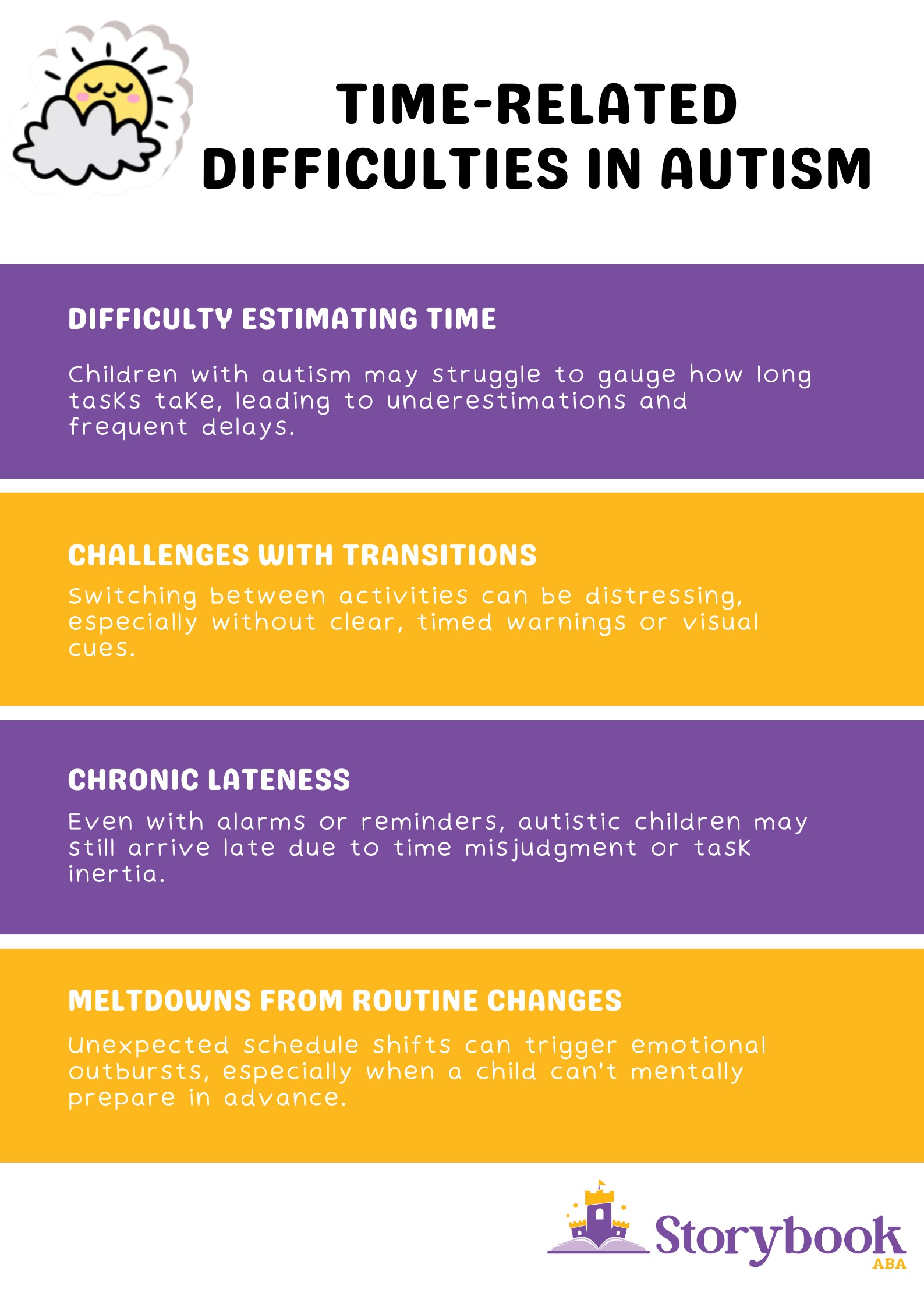
Common time-related difficulties in autism include:
Why Do Autistic Individuals Struggle with Time Awareness?
The root cause of time blindness in autism lies in executive functioning, a set of mental skills that include working memory, flexible thinking, and self-control. These cognitive skills help us manage time, organize tasks, and shift between actions. When executive function is impaired—as it often is in autistic individuals—time-based reasoning becomes inconsistent or unreliable.
Many autistic children live in the “now” because thinking ahead or reflecting on the past doesn’t come naturally. This isn’t just a philosophical problem—it’s a practical one.
Without an intuitive sense of how long 10 minutes feels, for example, a child can’t pace themselves on a task or prepare for the next activity. Additionally, sensory sensitivities and anxiety can amplify this disconnect, making time awareness even more difficult to develop—challenges that often overlap with broader cognitive differences explored in Memory Challenges in Autism: What You Should Know.
What Are the Signs of Time Blindness in Autism?
Time blindness can show up differently depending on age, developmental level, and co-occurring challenges like ADHD or anxiety. While it’s not officially listed in diagnostic criteria, it’s a well-documented behavioral challenge in both clinical research and real-life parenting experiences.
Look for patterns that go beyond typical procrastination or forgetfulness. The following are some key signs to watch out for:
1. Consistently Misjudging Time Needed for Tasks
Autistic children may repeatedly underestimate or overestimate how long daily tasks take, leading to frustration, lateness, or incomplete routines.
2. Intense Struggles with Transitions
Even minor shifts between activities can cause distress or shutdowns, especially when the child doesn’t sense that time is moving forward.
3. Ongoing Dependence on Adult Guidance
Older kids and teens may still need adult prompting for every transition, showing little internal sense of scheduling or urgency.
4. Irregular Timing on Assignments or Chores
They might race through a task too quickly or stall indefinitely, unable to self-monitor pacing or track elapsed time.
5. Fixation on Clocks Without Applying Time Concepts
Some children obsessively watch timers or clocks but don’t use them to manage tasks, indicating a disconnect between time awareness and function.

How Can Parents Help Manage Time Blindness in Autism?
Supporting a child with autism and time blindness requires patience, structure, and consistent tools. While it’s not something a child can simply “outgrow,” interventions and accommodations can dramatically promote independence and time awareness over time.
Start by meeting your child where they are, rather than where they “should” be. If abstract time concepts are hard to grasp, use visual or tactile tools to represent time. Combine those with routines that are predictable and gently reinforced. Avoid abrupt transitions or overly verbal explanations, and instead, use visual cues and step-by-step systems.
Effective strategies for managing time blindness include:
1. Use Visual Timers for Concrete Time Awareness
Tools like sand timers, countdown clocks, or Time Timers make time visible and tangible, helping children better grasp how long they have left.
2. Implement First-Then Boards to Clarify Sequencing
These simple visuals show what needs to happen now and what comes next, reducing anxiety and improving task follow-through.
3. Build Predictable Routines with Picture Schedules
Structured, visual daily schedules help children anticipate transitions and stay oriented throughout the day without relying on verbal reminders.
4. Reinforce On-Time Behavior with Rewards
Use consistent praise or tangible rewards to celebrate small successes, like finishing a task on time or transitioning without a meltdown.
5. Minimize Daily Transitions When Possible
Reducing the number of activities or transitions each day lowers stress and makes it easier for children to stay regulated and on task.
6. Consider ABA Strategies for Time-Based Skills
ABA therapy can teach time management step-by-step, using reinforcement and repetition to build routines that increase independence over time.
Is There a Connection Between Time Blindness and Other Conditions?
Yes, time blindness often overlaps with other conditions that affect executive function. ADHD is the most commonly associated, but anxiety disorders, OCD, and learning disabilities can also complicate time management.
This makes proper assessment critical. If your child is autistic and shows persistent time management difficulties, working with professionals who understand the broader neurodivergent landscape can help pinpoint effective interventions.
Autism itself already brings challenges in predictability and emotional regulation. When combined with time blindness, these issues can spiral into everyday struggles. Understanding the interconnected nature of these traits can help you find the right combination of support, accommodations, and therapeutic strategies.
Can Time Blindness Be Improved Over Time?
Time blindness is not a fixed trait. With consistent structure, targeted teaching, and the right therapeutic support, many children with autism can improve their time management skills over time. These changes may be slow and nonlinear, but they’re often meaningful and empowering.
Progress typically looks like fewer meltdowns during transitions, greater independence in routines, and more self-initiation. It’s also common for families to report improved mood and cooperation once time-based expectations become clearer and more concrete. Still, time awareness will likely remain a work in progress, so ongoing support from behavior specialists can be vital.
Why ABA Therapy Can Be a Game-Changer for Time Management
Applied Behavior Analysis (ABA) therapy is uniquely suited to address time blindness because of its structured, skills-based approach. ABA breaks down complex behaviors like time estimation, routine following, and transition readiness into smaller, teachable skills. Therapists work with children to build habits, monitor progress, and reinforce successes.
Rather than relying on abstract verbal reminders, ABA uses data-driven strategies to create routines that make sense to the child. Whether through visual schedules, reinforcement systems, or caregiver coaching, ABA can improve how children understand, plan, and adapt to time-related tasks.
Get the Right Support with ABA Therapy
If your child is navigating the challenges of autism and time blindness, structured support can make all the difference. Storybook ABA offers customized ABA therapy in Maryland and Virginia, designed to help children build meaningful, lifelong skills like time management, task completion, and routine mastery.
Our team specializes in breaking down daily routines into teachable steps, helping families create environments where children can thrive. If time struggles are creating chaos at home or school, contact us today and let us help you bring back consistency and calm through a behavior-based approach that truly works.