

Key Points:
- Breathing exercises help children with autism manage anxiety, sensory overload, and emotional regulation challenges.
- Techniques like box breathing, balloon breathing, and visual supports make breathwork more accessible and engaging for neurodivergent kids.
- Breathing practice becomes more effective when embedded into daily routines with consistent reinforcement from caregivers and therapists.
For many children on the autism spectrum, emotional regulation, anxiety, and sensory processing can be overwhelming. In fact, studies indicate that approximately 1 in 3 autistic children experience anxiety symptoms. These experiences often build up internally and appear externally as meltdowns, avoidance, or shutdowns.
Autism breathing exercises provide a practical and calming way for children to self-regulate. Unlike verbal strategies that require expressive language, breathing techniques work regardless of a child’s communication level.
In this article, we’ll go over the different breathing exercises for autism, their several benefits, and other techniques that can help manage autism symptoms for better well-being.
What Are Breathing Exercises for Autism?
Breathing exercises are structured techniques that help children on the spectrum control their breathing to promote relaxation, focus, and emotional regulation. These exercises reduce anxiety, improve sensory integration, and support overall self-regulation when practiced regularly.
Many children with autism experience irregular breathing patterns during stress, either rapid, shallow breaths or breath-holding. Breathwork counters these patterns and provides a predictable, physical way to slow down and refocus. With practice, children can learn to use breathing techniques to manage transitions, respond to frustration, or recover from overstimulation.
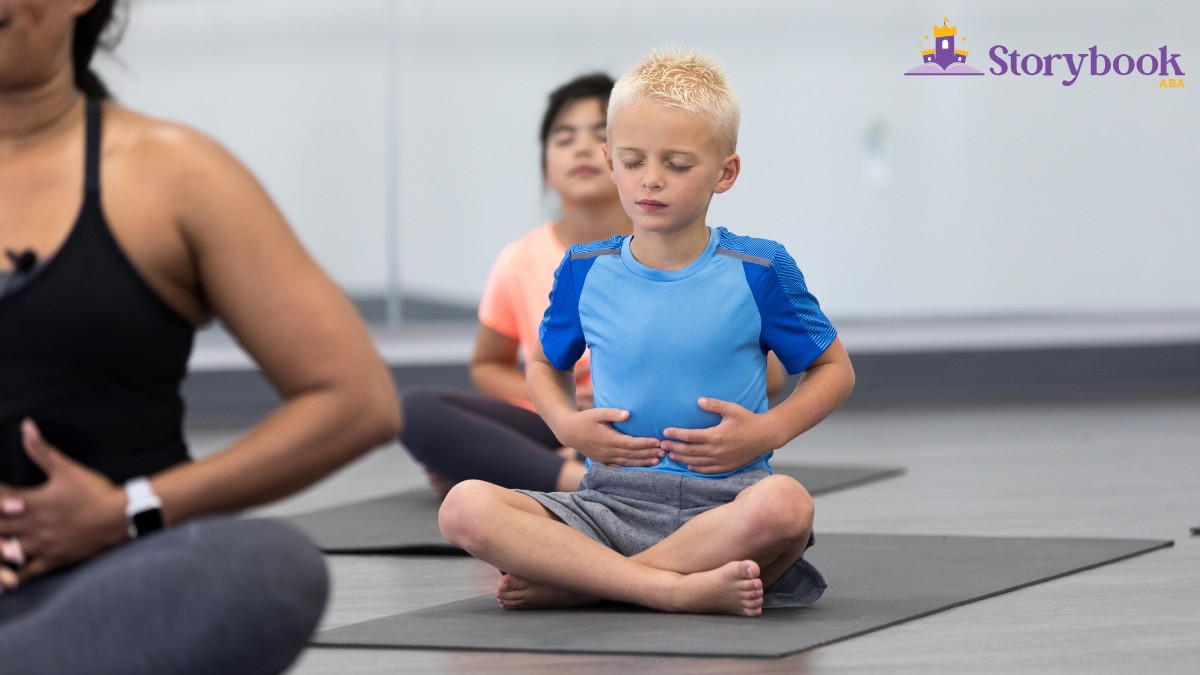
Why Are Breathing Exercises Helpful for Kids with Autism?
Autistic children often face difficulty in recognizing their internal states or managing responses to external triggers. These challenges can lead to sudden emotional shifts, behavioral outbursts, or complete emotional shutdown. Breathing exercises offer a low-effort yet high-impact tool for calming the nervous system and creating a sense of control.
Breathing practices activate the parasympathetic nervous system, which is responsible for calming the body after a stress response. This makes breathwork especially valuable for children who are easily dysregulated by noise, touch, or rapid changes in environment. When breathing becomes a learned coping tool, it allows children to process big emotions without being overwhelmed by them.
When Should Breathing Techniques Be Used?
Timing and consistency are key when introducing any new calming strategy, especially for neurodivergent learners. Breathing exercises are most effective when they are introduced before a child is in a state of crisis.
They can be used proactively, reactively, and routinely to create structure around emotional regulation:
- Before transitions (e.g., leaving for school, bedtime, ending an activity).
- During signs of distress (e.g., pacing, crying, agitation).
- After meltdowns or shutdowns, to restore baseline and recover.
- As part of daily routines, such as during morning check-ins or bedtime wind-down.
The more breathing is practiced during calm times, the easier it becomes for children to access it during stress.
What Are the Best Breathing Exercises for Autism?
Some breathing strategies may be too abstract for younger children or those with limited verbal skills. That’s why visual, sensory, and play-based breathing exercises work best. Below are effective options adapted for various developmental levels and sensory preferences.
Recommended breathing techniques include:
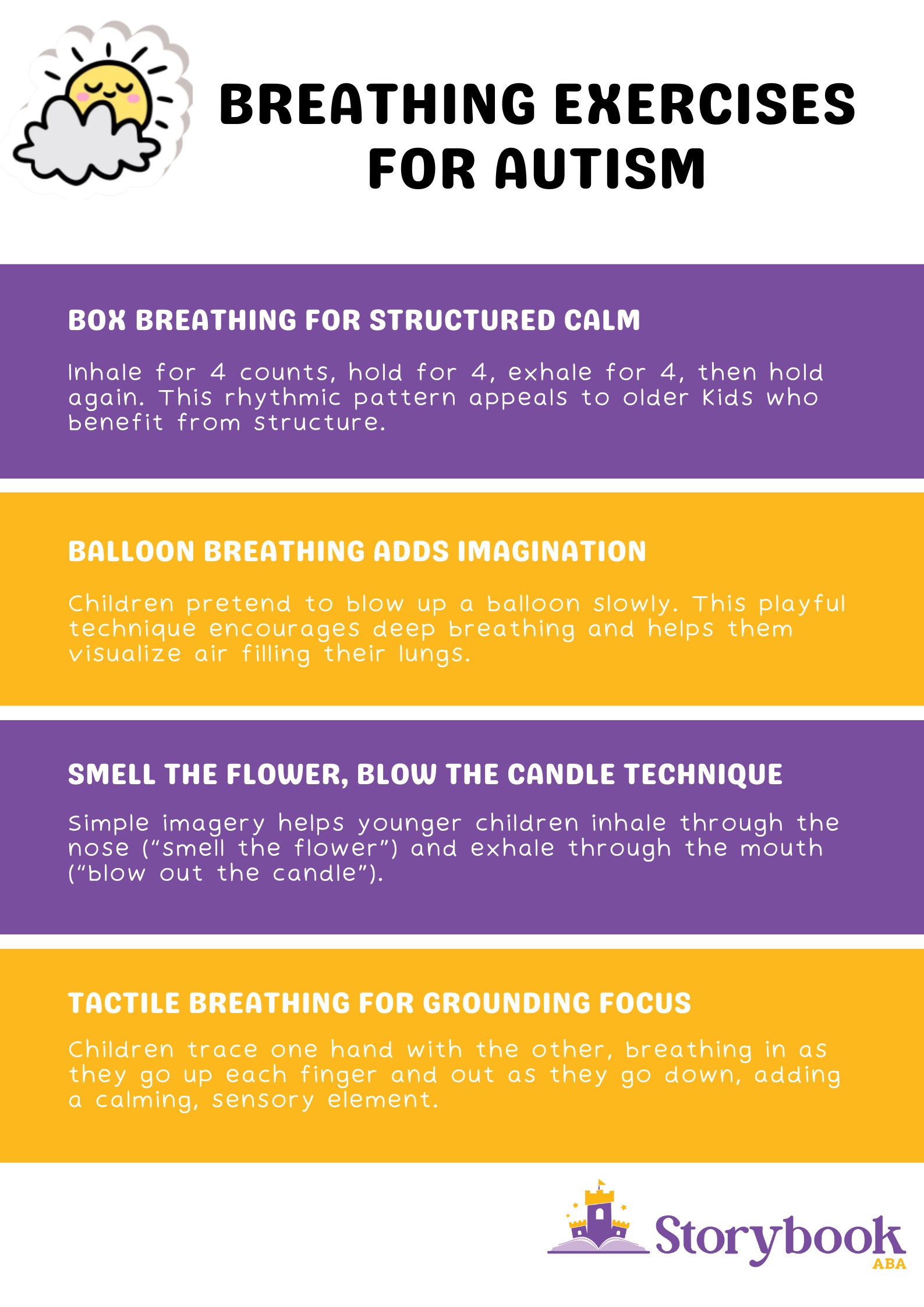
Each of these techniques can be personalized. Letting the child choose their favorite or modifying based on their sensory needs increases buy-in.
How Often Should Children Practice Breathing Techniques?
Children should ideally practice breathing techniques daily, even during calm moments. Practicing for just 3 to 5 minutes a day can significantly improve their ability to manage emotions and self-regulate. By incorporating these techniques into low-stress parts of the day—like morning routines, after school, or before bedtime—children begin to build a strong, positive connection with the practice.
When breathing techniques are introduced only during high-stress situations, children may feel resistant or too overwhelmed to use them effectively. Instead, practicing regularly in relaxed settings allows them to master the skill and use it more automatically when emotions run high. Over time, daily practice can reduce the intensity of emotional outbursts, improve focus, and support overall emotional development—offering insight into why some individuals may respond to emotional stimuli more intensely than others, as explored in Why Do Some Autistic People Feel More Deeply Than Others?
How Can Parents Make Breathing Exercises More Engaging?
It’s not always easy to get kids—especially those who are already anxious—to stop and breathe. To make breathwork accessible and successful, it should feel familiar, fun, and predictable. Children are more likely to participate if they understand the purpose and see it as part of their daily life.
Engagement strategies include:
1. Use Visual Aids to Make Breathing Tangible
Cards, posters, and laminated prompts provide a concrete, visual anchor for abstract breathing concepts. These tools help children follow along without relying on complex verbal directions.
2. Practice When Calm to Build Familiarity
Introducing breathing techniques during calm, low-pressure moments helps children feel safe and curious rather than resistant. This builds comfort and routine around the practice.
3. Connect Breathwork to Enjoyable Activities
Pair breathing with favorite activities like music, movement, or storytelling. For example, pretend to blow out candles during a birthday-themed story or use breath to “move” imaginary objects.
4. Offer Simple, Clear Choices
Letting children pick between two or three techniques (e.g., starfish vs. balloon breathing) gives them a sense of control and ownership over the process.
5. Use Timers or Rhythm Tools
Short videos, sand timers, or songs with a steady beat can help pace each breath and keep children engaged through structure and repetition.
Some families also use reward systems at the beginning to reinforce participation, then fade these as the child becomes more independent.
How Do Breathing Exercises Support ABA Therapy?
Applied Behavior Analysis (ABA) is built around structured, evidence-based interventions for behavior and skill-building. While breathing exercises may seem simple, they align well with ABA’s principles, especially for teaching replacement behaviors and self-regulation skills.
Therapists often use breathing techniques as part of a larger behavior plan to reduce problem behavior and teach coping responses. For example, instead of hitting or screaming when upset, the child is taught to take deep breaths as a replacement behavior.
ABA therapists may use breathwork to:
- Teach emotion regulation during functional behavior training.
- Reinforce calm behaviors with preferred rewards.
- Build routines with visual schedules that include breath breaks.
- Use prompting and modeling to guide breathwork during therapy sessions.
- Embed breathwork into social stories and role-play.
Parents who learn these strategies during ABA sessions can apply them at home for greater consistency across environments.
Support Your Child’s Well-Being with ABA Therapy
Children on the autism spectrum benefit from tools that are simple, consistent, and adaptable. Breathing exercises are one of the most effective ways to reduce anxiety, manage sensory overload, and promote calm, even when words aren’t available. At Storybook ABA, we use structured behavioral strategies like these to help children regulate emotions and succeed in their daily environments.
Our programs are tailored to meet each child’s needs and are rooted in evidence-based approaches that promote independence and growth. Through ABA therapy in Virginia and Maryland, our team helps families integrate calming strategies—including breathwork—into their routines at home, school, and in the community.
Contact us today to explore personalized ABA therapy that empowers your child to breathe easier, regulate better, and thrive with confidence.