

Key Points:
- Hypervigilance is common in individuals with autism and often stems from heightened sensory sensitivity, anxiety, and past stress.
- Recognizing signs of hyper-awareness helps parents and caregivers support emotional regulation and reduce environmental stressors.
- Applied Behavior Analysis (ABA) offers structured strategies to help children cope with and reduce hypervigilant behaviors.
For many families navigating an autism diagnosis, understanding what drives a child’s behaviors is key to offering the right support. One issue that can be easily misunderstood is hypervigilance.
The link between hypervigilance and autism often surfaces when a child appears to be “on edge,” constantly scanning their surroundings, or reacting strongly to small changes. These behaviors aren’t random—they reflect a deeper need to feel safe and in control in a world that often feels overwhelming.
In this article, we’ll explore the connection between hypervigilance in autism, how it can manifest in everyday life, and offer some tips to help ease the symptoms.
What Is the Connection Between Hypervigilance and Autism?
Hypervigilance and autism are connected through heightened sensory sensitivity, emotional dysregulation, and anxiety that often accompany neurodevelopmental differences. Children with autism may exhibit constant alertness, startle easily, or struggle to relax in unpredictable environments.
This persistent state of over-awareness is not just about being observant. It’s rooted in the brain’s stress-response system. When environments are loud, fast-paced, or emotionally unclear, some autistic individuals may remain in a near-constant state of “fight or flight.” Hypervigilance becomes a coping mechanism—an unconscious attempt to stay one step ahead of perceived threats.
What Does Hypervigilance Look Like in Autistic Children?
Parents might not immediately recognize hypervigilance for what it is. On the surface, it may seem like intense curiosity or anxiousness. But over time, consistent patterns emerge that signal chronic overstimulation or mistrust of surroundings.
Children who are hypervigilant may:
- Constantly scan rooms or people without fully engaging.
- Startle easily at unexpected sounds, movements, or changes in lighting.
- Avoid eye contact while still keeping tabs on everyone.
- Struggle to sleep or relax, even in quiet settings.
- Fixate on small details or changes in routine.
These signs often co-occur with sensory sensitivities or trauma-related responses. For children with both autism and anxiety, hypervigilance may intensify in new environments or around unfamiliar people.
What Causes Hypervigilance in Children With Autism?
Hypervigilance doesn’t happen in isolation. It’s typically a learned or conditioned response to ongoing discomfort or unpredictability in the child’s environment. Children with autism often process sensory and social input differently. When this input feels chaotic, they may develop hyper-alert behaviors as a way to stay in control.
Common contributing factors include:
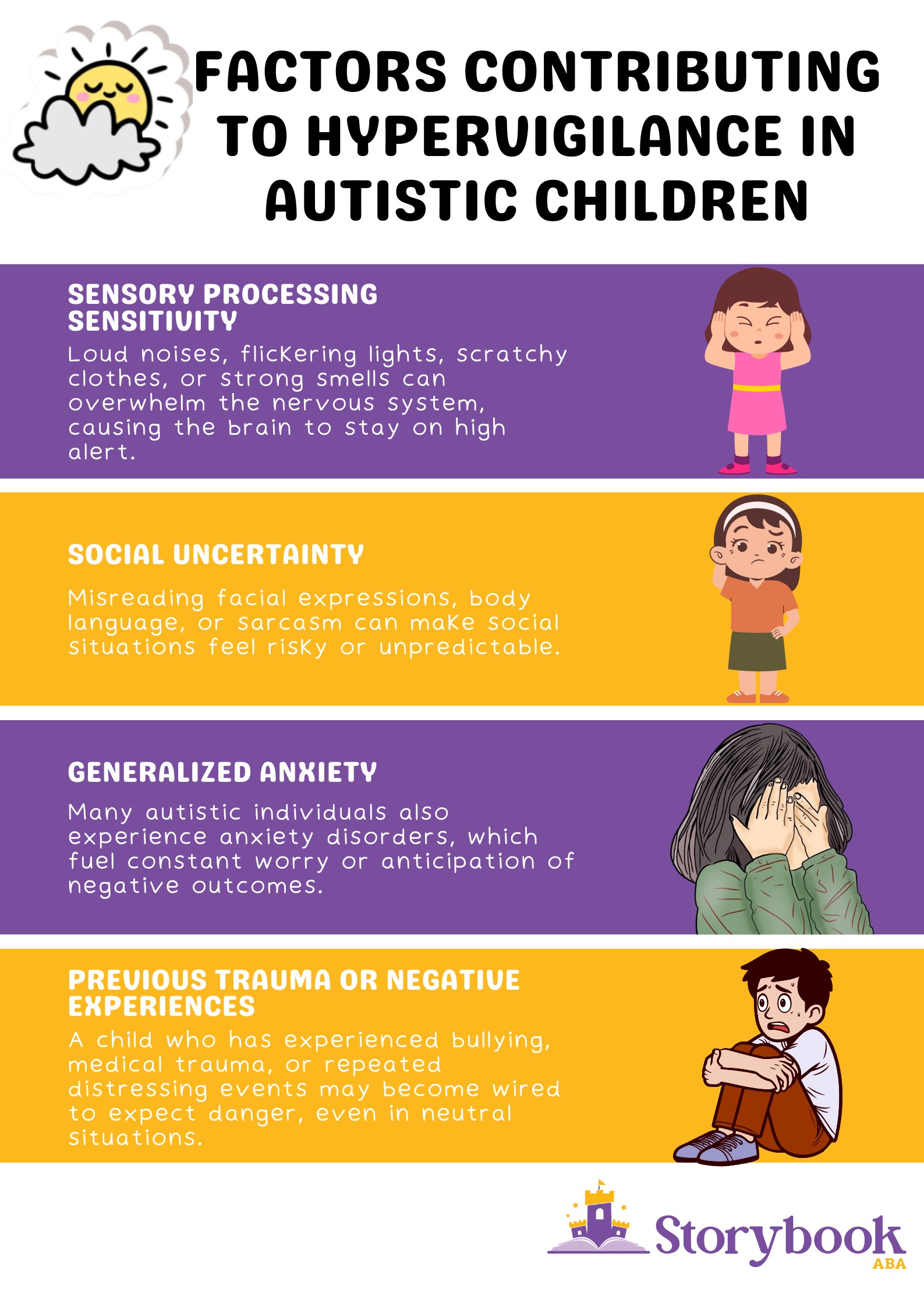
Understanding the cause of hypervigilance helps inform the best support strategies. Often, reducing the stressors that trigger this behavior is the first step toward relief.
Do All Autistic Individuals Experience Hypervigilance?
Not all autistic individuals experience hypervigilance, but many do due to heightened sensory sensitivity, anxiety, or trauma responses. Hypervigilance involves a constant state of alertness, often triggered by overwhelming environments, unpredictable social cues, or past negative experiences.
For some on the autism spectrum, this can lead to exhaustion, difficulty focusing, and a strong need for routine and control to feel safe. However, each autistic person is different, and while some may show signs of hypervigilance, others may not experience it at all or may express it in subtler ways. Understanding and supporting each person’s unique sensory and emotional needs is key—especially during transitions or moments of separation, which can be particularly challenging. For more guidance on this, see How to Handle Separation Anxiety in Autistic Children.
How Does Hypervigilance Affect Daily Life?
The impact of hypervigilance can be wide-ranging. While some children may appear well-behaved or quiet, their internal state is often one of tension or stress. Over time, this can affect sleep, attention, learning, and relationships.
Common challenges of hypervigilance include:
1. Struggles with Focus in Classrooms
Children experiencing hypervigilance often scan their environment for threats, making it difficult to concentrate on lessons or tasks.
2. Difficulty Building Peer Relationships
Guarded behavior and constant alertness can make social interactions feel risky, leading to withdrawal or limited peer bonding.
3. Disrupted Sleep Patterns
Hypervigilant children may have trouble winding down at night, leading to insomnia, nightmares, or restless sleep.
4. Emotional Overload and Meltdowns
Prolonged stress can build up internally, resulting in sudden emotional outbursts or complete shutdowns when overwhelmed.
5. Avoidance of Crowded or Noisy Places
Loud, busy environments often feel unsafe, prompting children to avoid places like malls, restaurants, or school events.
6. Increased Isolation Without Support
Without intervention, hypervigilance can lead to greater emotional distance, inflexibility, and resistance to new experiences or changes.
Without targeted support, children may become increasingly isolated or resistant to change. That’s why early identification and intervention are crucial.
How Can Parents Support a Child Experiencing Hypervigilance?
Support starts with observation and empathy. Parents don’t need to eliminate all discomfort, but reducing avoidable triggers and helping children learn coping skills can make daily life more manageable.
Practical support strategies include:
1. Create a Predictable Routine
Establishing a steady, reliable daily schedule helps reduce anxiety by giving the child a sense of control. Visual schedules and countdowns for transitions can ease the mental burden of anticipating change.
2. Offer Quiet Recovery Spaces
Design a dedicated calm space at home with soft textures, dim lighting, and tools like weighted blankets or fidget items. These spaces give children a safe retreat to decompress and regulate after stressful moments.
3. Use Social Stories to Set Expectations
Social stories explain common scenarios in a simple, reassuring way, helping children understand social cues and expected behaviors. This predictability reduces the need to stay constantly alert in unfamiliar settings.
4. Model Calm, Predictable Responses
Your demeanor matters. When parents stay calm and consistent, especially during challenging moments, it signals safety. Speak in a gentle tone and move slowly to help soothe an already overwhelmed child.
5. Limit Overwhelming Environments
Avoid or prepare carefully for settings with excessive noise, unpredictable crowds, or bright lights. Sensory-friendly alternatives or pre-visit planning can make outings more manageable and less triggering.
Supporting hypervigilance isn’t about eliminating all challenges, but it’s about helping the child feel safe enough to engage, learn, and relax.
What Role Does ABA Therapy Play in Managing Hypervigilance?
Applied Behavior Analysis (ABA) can be an effective tool in understanding and reducing hypervigilant behaviors. ABA is built on the idea that behaviors are learned responses to environmental conditions. That means with consistent support and reinforcement, children can replace high-alert responses with healthier coping strategies.
In ABA therapy, behavior analysts look for the function behind the child’s hypervigilant behaviors—what triggers them, what maintains them, and what could be changed to support a better outcome.
ABA Therapy helps support hypervigilance by:
- Identifying triggers and patterns of stress or discomfort.
- Teaching replacement behaviors, like asking for help or using a break card.
- Building tolerance for change or new environments using gradual exposure.
- Improving communication, which reduces fear-based responses.
- Collaborating with families to implement consistent strategies across settings.
By addressing both the cause and the response, ABA can help children become less reactive, more engaged, and better able to self-regulate.
Get Support for Real Change with ABA Therapy
When children experience the world as unpredictable or overwhelming, their behaviors often reflect a deep need for safety. Hypervigilance, while challenging, is a response that can be understood and supported through structure, consistency, and targeted teaching.
At Storybook ABA, our team specializes in guiding children toward more adaptive, functional behaviors using evidence-based strategies. Through ABA therapy in Maryland and Virginia, we help families create safer, more predictable environments where children can learn, relax, and thrive.
Contact us today to learn how ABA therapy can support your child’s emotional regulation, reduce hypervigilance, and build confidence—one step at a time.