
Key Points:
- Autism can affect different types of memory, with strengths in certain areas like rote memory and challenges in others like working memory.
- Brain function differences in autism impact how information is processed, stored, and recalled over time.
- Understanding memory profiles in autism helps caregivers and educators offer more effective, individualized support.
Autism doesn’t just affect how children communicate or interact—it also shapes how they take in, store, and retrieve information. One area that often goes overlooked is memory. While many autistic individuals display remarkable memory in certain areas, such as facts or sequences, research indicates that they may face real challenges with working memory or recalling personal experiences.
In this article, we’ll go over how autism influences different types of memory, how brain function plays a role, and what these differences mean for daily life. By understanding your child’s memory strengths and struggles, you can better support them at home, in school, and through therapies like ABA.
Does Autism Affect Memory?
Yes, autism can affect memory, especially working memory and episodic memory, while other areas like rote memory or visual memory may remain strong or even enhanced.
Autistic individuals often show a unique memory profile. They may excel at memorizing facts, dates, and sequences (rote memory) but struggle to recall personal experiences (episodic memory) or manage tasks that require mental flexibility (working memory). These differences in memory aren’t deficits in intelligence—they reflect how the autistic brain is wired to process and prioritize information.
How Is Memory Function Different in Autistic Children?
Memory function in autism doesn’t follow a one-size-fits-all pattern. Many children on the spectrum show uneven cognitive profiles, with some memory types being stronger than others. These variations are tied closely to differences in brain development, particularly in areas related to attention, executive function, and sensory processing.
Autistic children often have heightened ability in rote memory—the recall of specific facts or patterns. This might explain why some can remember the exact order of dinosaur species or repeat entire movie scripts. However, when it comes to working memory (holding information temporarily for immediate use) or episodic memory (recollecting personal experiences), challenges are more likely to occur.
The interplay between attention, sensory input, and emotional regulation can make it harder for the brain to encode and retrieve memories consistently. This isn’t about capacity, but about access and organization.
What Types of Memory Are Commonly Affected by Autism?
Memory is not a single system. It includes multiple subtypes, each of which can be affected differently in children with autism. Recognizing the distinctions helps caregivers know where their child might need extra support.
Here’s a breakdown of memory types and how they may be impacted:
1. Working Memory
Working memory helps us hold and manipulate information temporarily, like remembering a phone number long enough to dial it. Autistic individuals often struggle with this type of memory, especially in high-stimulus or multitasking environments.
Common signs of working memory challenges include:
- Difficulty following multi-step instructions
- Trouble with mental math or reading comprehension
- Forgetting what they were just told
2. Episodic Memory
This refers to the ability to recall specific events or experiences from one’s life. Children with autism may find it harder to access detailed memories of personal events, particularly those involving emotional or social context.
Examples of episodic memory difficulties include:
- Struggling to recall what happened during recess or a recent outing
- Inconsistent storytelling about past experiences
- Limited self-referential memory
3. Procedural Memory
This is the memory of how to perform tasks or routines. It tends to be preserved or even strengthened in many autistic children. Positive examples of procedural memory in autism include:
- Mastering complex routines like assembling puzzles or using tech devices
- Remembering habitual steps in daily routines (e.g., brushing teeth, setting the table)
4. Rote Memory
Autistic children often have strong rote memory. They can memorize songs, dates, scripts, or lists with precision. Signs of strong rote memory include:
- Repeating long phrases or facts verbatim
- Strong recall of historical dates, maps, or spelling
- Fascination with categories or sequences
Understanding your child’s memory strengths can open up new learning pathways, especially when leveraged through repetition and visual supports.
What Brain Differences Influence Memory in Autism?
Several structural and functional brain differences contribute to how memory works in individuals with autism. The prefrontal cortex, responsible for planning and decision-making, is linked to working memory. In autistic children, this area may show less synchronized activity with other brain regions, leading to challenges in multitasking or remembering sequences.
The hippocampus, crucial for forming long-term memories, can also function differently. Its interaction with emotional centers like the amygdala influences whether memories are stored and how easily they are recalled. Emotional experiences may not be encoded in the same way, which could explain gaps in autobiographical memory or reduced emotional resonance when recalling events.
Sensory processing differences also play a major role. If a child is overwhelmed by sensory input, their brain may prioritize coping over storing information, making memory encoding harder in overstimulating environments. Understanding these challenges is crucial for supporting cognitive skills, which is why we invite you to explore our article, How to Improve Executive Function in Autism, for practical strategies and insights.

What Everyday Behaviors Can Memory Challenges Affect?
Memory difficulties in autistic children can influence many day-to-day behaviors. These aren’t always obvious but can have a cumulative impact on learning, communication, and emotional well-being.
For instance, a child may struggle to remember classroom routines, even after repeated exposure, simply because the instructions involve multi-step tasks that exceed their working memory limits. They may also appear inattentive or oppositional when they actually just forgot part of an instruction.
Areas impacted by memory challenges include:
1. Schoolwork Challenges
Memory issues can make it difficult for autistic children to follow multi-step instructions, remember sequences in math, or retain reading comprehension. Even when they understand concepts, poor working memory may cause them to appear distracted, confused, or inconsistent in academic tasks.
2. Social Interaction Difficulties
Children may forget past conversations, names, or shared experiences, making it harder to maintain relationships. They might unintentionally repeat themselves or miss context in peer interactions, which can lead to misunderstandings or the appearance of social withdrawal or disinterest.
3. Emotional Regulation Struggles
When children can’t access memories of past calming strategies or emotional experiences, it becomes harder to regulate behavior during stress. This can lead to disproportionate reactions or meltdowns because the brain lacks the recall tools needed to self-soothe.
4. Inconsistent Daily Living Skills
Routines like brushing teeth or setting the table may be forgotten mid-task. Despite repeated practice, memory difficulties can cause irregular follow-through, which is often misinterpreted as defiance or laziness rather than a need for structured reminders.
When memory-related behaviors are misinterpreted as defiance or laziness, children may face inappropriate discipline instead of the support they need.
How Can Parents Support Memory Development at Home?
While some memory challenges are rooted in neurological wiring, that doesn’t mean they can’t be supported. Parents can use practical strategies at home to help their child strengthen memory skills and compensate for challenges in daily life.
You don’t need advanced tools—just consistency, visual supports, and patience.
Memory support strategies for home include:
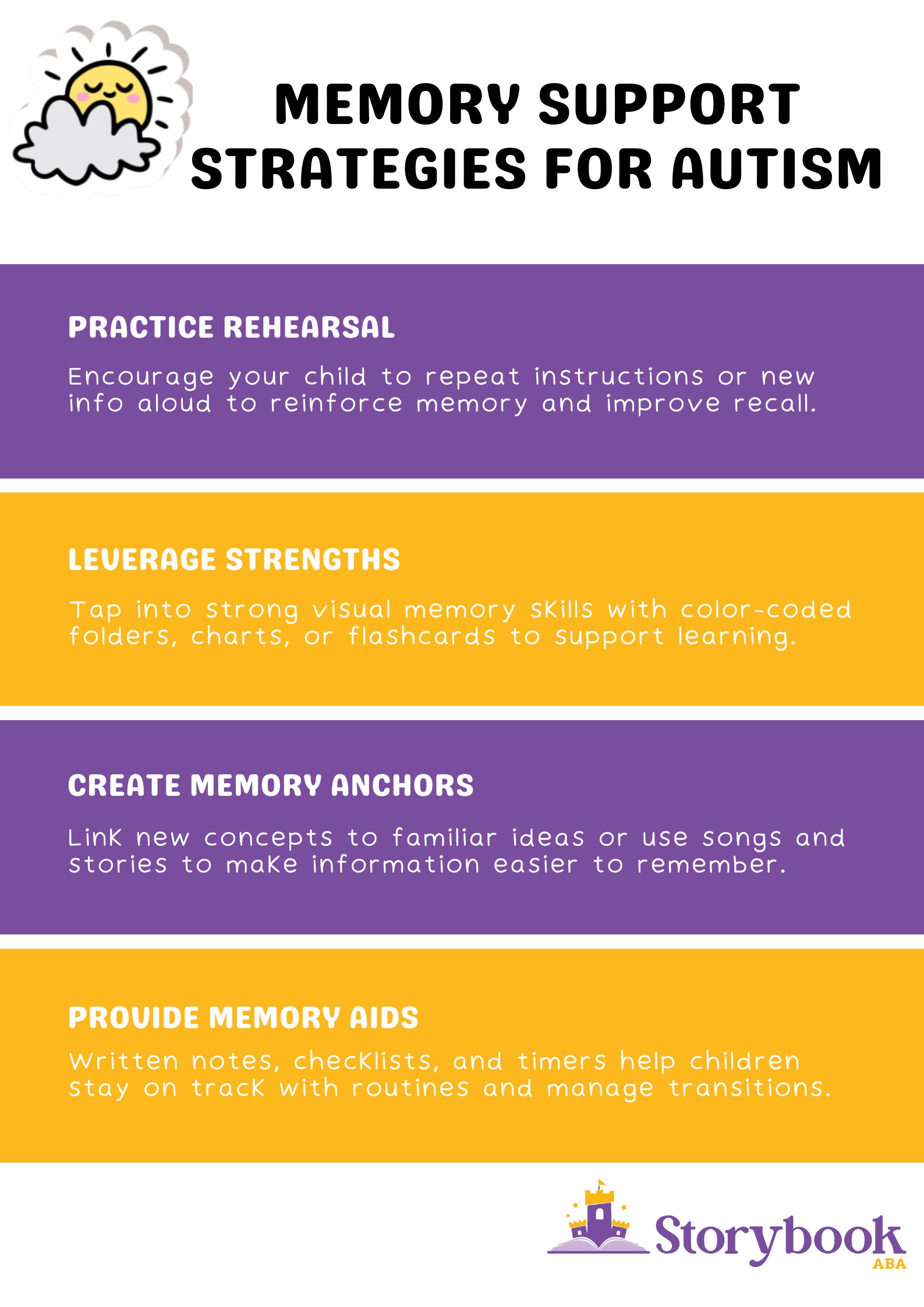
These small changes add up. Consistency and patience can make a noticeable difference in how your child remembers and organizes their world.
Can ABA Therapy Help with Memory-Related Challenges?
Absolutely. Applied Behavior Analysis (ABA) therapy can target specific memory-related challenges by improving attention, working memory, and executive functioning skills. Therapy doesn’t aim to change how memory works fundamentally, but instead focuses on building support strategies that work with the child’s strengths.
ABA practitioners assess each child’s learning profile and adapt interventions accordingly. They use evidence-based methods to teach new skills, reduce cognitive load, and build independence.
When done ethically and responsibly, ABA therapy empowers children to succeed, not by forcing conformity, but by reinforcing understanding and access to learning.
Encourage Your Child’s Progress with ABA Therapy
If your child is struggling with memory challenges related to autism, Storybook ABA offers individualized, compassionate ABA therapy in Virginia and Maryland. Our approach supports children in building the skills they need to navigate the world more independently, with a strong focus on functional outcomes.
Whether it’s improving working memory, developing daily routines, or enhancing learning strategies, our therapists tailor every session to your child’s unique profile. We use structured routines, visual aids, and repetition—all grounded in a trauma-informed, family-centered approach.
Contact us today to learn more about how ABA therapy can help support your child’s memory development and overall growth.