

Key Points:
- Executive function challenges in autism affect planning, organization, flexibility, and working memory.
- Structured routines, visual supports, and task breakdowns are crucial strategies for building executive skills.
- ABA therapy offers tailored, measurable interventions that can significantly strengthen executive functioning over time.
Executive function deficits are among the most common and life-impacting traits associated with autism, with at least 41% of autistic individuals exhibiting executive dysfunction. These cognitive skills—such as planning ahead, regulating behavior, shifting attention, and remembering steps in a task—can be deeply affected, making daily life unpredictable and frustrating for both the child and their caregivers.
If you’re searching for how to improve executive function in autism, it’s likely because these challenges are interfering with learning, transitions, or independence. The good news is that there are proven ways to build these skills using consistent, practical methods grounded in behavioral science, which we’ll discuss in this article.
How Can You Improve Executive Function in Autism?
Executive function in autism can be improved through consistent practice, structured environments, and behavioral strategies tailored to each individual’s needs. Interventions should focus on breaking down tasks, building routines, using visual aids, and teaching time management and self-regulation skills.
Because executive functioning is not a single skill but a system of related processes, improvement takes a multifaceted approach. It’s about helping children plan, stay organized, control impulses, and shift gears smoothly—skills that don’t always come naturally but can be taught over time.
What Is Executive Function and Why Is It Important?
Executive function refers to a set of mental skills controlled by the brain’s prefrontal cortex. These skills include things like flexible thinking, impulse control, attention regulation, and problem-solving. Children with autism often experience delays or impairments in these areas, which can make everyday tasks more difficult.
A child may know what they should do, but still struggle to initiate or complete the task. That’s not defiance or laziness—it’s a breakdown in how the brain organizes behavior. Executive function influences how children follow instructions, handle transitions, complete assignments, and cope with changes in routine. When these processes are weak, a child’s potential is often hidden behind avoidable struggles.
What Are the Signs of Poor Executive Function in Autism?
The signs can vary based on age and developmental level, but many children with autism show clear markers of executive function difficulties. These challenges often surface during transitions, schoolwork, and social problem-solving situations.
Below are common indicators that a child may be struggling with executive function:
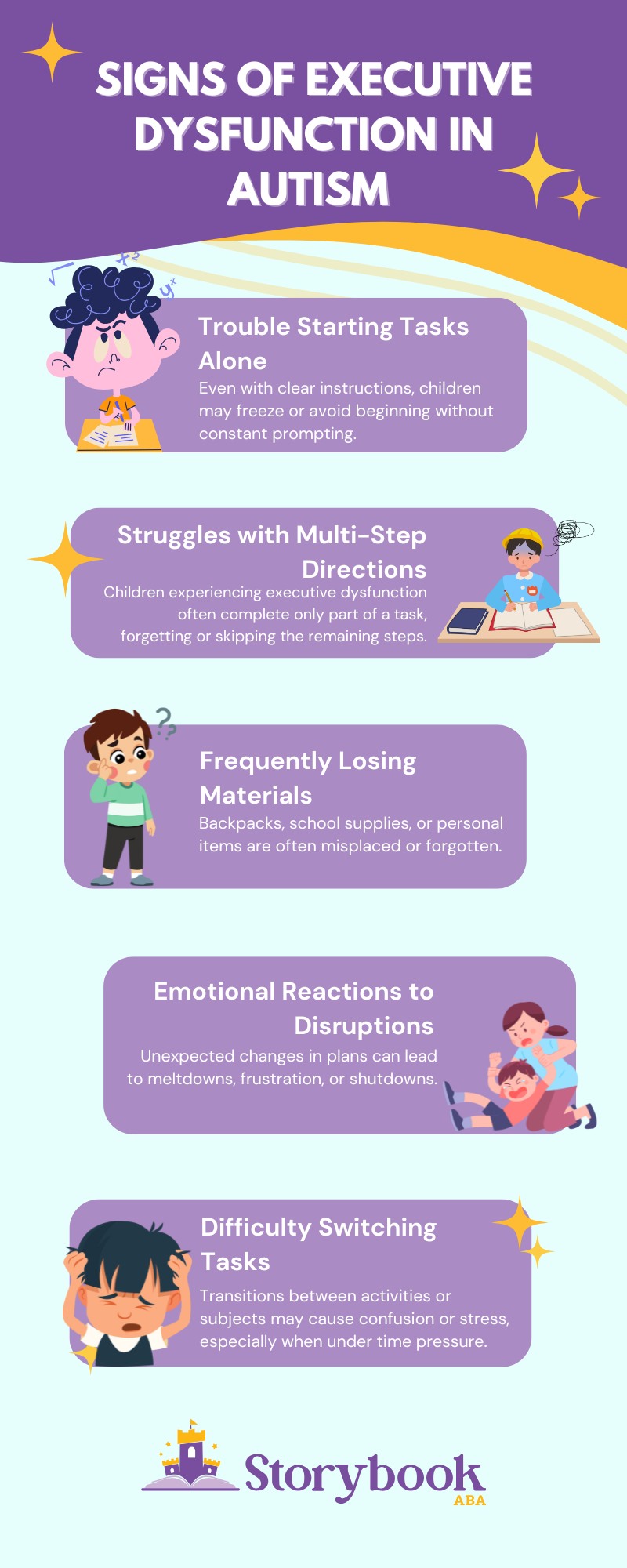
Understanding these signs helps parents and educators create support that reduces stress and increases success for the child.
Why Is Executive Function Especially Challenging in Autism?
The neural pathways involved in executive function are often underdeveloped or function differently in autistic individuals. That includes the prefrontal cortex and its connections to other brain regions responsible for emotional regulation, working memory, and decision-making.
Moreover, autism often includes rigid thinking patterns and difficulty shifting attention. Combined with sensory sensitivities and communication barriers, these traits can make planning and organizing especially difficult. For some children, just knowing what to do next can feel overwhelming—a challenge that underscores the importance of learning effective coping strategies, as explored in How Autistic Individuals Can Reduce Daily Stress and Overload.
What Are the Best Strategies to Build Executive Function Skills?
Improving executive function in autism starts with recognizing that these are teachable skills. Like reading or math, they need repetition, structure, and supportive tools. The earlier you begin building these habits, the more progress you’re likely to see.
Below are highly effective strategies used at home, in school, and in therapy settings:
1. Use Visual Schedules
Children with autism often process information better visually than verbally. Visual schedules reduce anxiety by making expectations concrete and predictable. These include:
- Daily picture schedules with icons for morning, afternoon, and evening.
- “First-Then” charts to show short-term expectations and rewards.
- Step-by-step breakdowns for routines like brushing teeth or packing a bag.
2. Break Down Tasks Into Smaller Steps
Large tasks can be overwhelming. Breaking them into small, achievable actions supports memory and reduces task refusal. These include:
- Write or show steps clearly (e.g., “1. Open folder, 2. Take out worksheet, 3. Write your name”).
- Reinforce each small success before moving to the next.
3. Use Timers and Countdown Tools
Time blindness is often part of executive dysfunction. Visual timers and countdowns help children prepare for transitions and manage tasks more independently. These include:
- Sand timers, color-changing timers, or visual apps.
- Set reminders that count down to the next activity.
4. Create Predictable Routines
Routine supports working memory and reduces the cognitive load required to figure out what comes next. These involve:
- Keeping morning and bedtime routines the same each day.
- Using consistent language and cues for transitions.
- Establishing simple, reliable routines
5. Practice Impulse Control Through Games
Turn-taking games, memory games, or Simon Says help children build control in a fun and low-pressure way. These include:
- Starting with short, engaging activities and extending as attention improves.
- Reinforcing effort, not just success.
How Can ABA Therapy Help with Executive Functioning?
Applied Behavior Analysis (ABA) is one of the most effective interventions for improving executive function in children with autism. ABA works by breaking down complex behaviors into teachable steps, using reinforcement, repetition, and data tracking to build lasting skills.
Executive functions like shifting tasks, following directions, or waiting turn are not treated as abstract ideas—they’re transformed into measurable goals. ABA therapists help children practice these skills in real-life situations, adjusting the environment and prompts as needed to ensure success.
ABA support for executive function includes:
- Teaching flexible thinking through gradual exposure to changes.
- Building task initiation by reinforcing the first step.
- Reducing meltdowns during transitions with visual cues and routines.
- Tracking progress with data so strategies are personalized and responsive.
Most importantly, ABA doesn’t just benefit the child—it also equips parents and caregivers with tools to support executive function at home.
Can Executive Functioning Improve Over Time?
Yes, many children with autism make significant gains in executive functioning over time, especially when provided with structure, repetition, and individualized support. Improvements may include fewer meltdowns, better self-starting behaviors, more successful transitions, and growing independence in daily tasks.
Progress isn’t linear, and setbacks are part of the process. But with the right interventions—especially those that target specific skill sets—children can build more control over their behavior, attention, and organization. The key is consistency and customization.
Parents often report that once executive functioning improves, their child’s ability to learn and interact with others also grows, leading to better outcomes across the board.
Empower Your Child with ABA Therapy
If your child struggles with planning, organizing, or shifting between activities, they may be experiencing executive function delays related to autism. At Storybook ABA, we specialize in structured, personalized ABA therapy in Virginia and Maryland that helps children build foundational executive functioning skills—step by step.
Our team uses behavior-based strategies grounded in real-world success. Whether it’s learning to follow routines, manage time, or complete tasks independently, our programs are designed with your child’s unique strengths and challenges in mind.
Reach out to us today to learn how we can support your child’s growth and independence through targeted ABA therapy.