
Key Points:
- Speech delay and autism can overlap in symptoms, but they differ significantly in social and behavioral patterns.
- Understanding the root cause of delayed communication is essential for proper intervention and support.
- Parents can look for unique social cues, repetitive behaviors, and language usage differences to distinguish between the two.
Noticing that your child isn’t speaking at the expected age can be deeply concerning. According to studies, 1 in 5 children may struggle to talk or use words compared to their peers. While some children simply develop language skills later than others, others may be showing early signs of a broader developmental difference.
One of the top concerns parents face is understanding the difference between a speech delay and autism. Recognizing whether your child’s language challenges stem from speech delay in autism or an isolated speech issue is essential for getting the right support early on.
What Is the Difference Between Speech Delay and Autism?
Speech delay in autism is typically accompanied by social, behavioral, and cognitive challenges, while isolated speech delays involve limited speech issues without broader developmental differences.
Speech delays alone don’t usually involve challenges in eye contact, pretend play, or understanding social cues. In contrast, children with autism often experience communication issues alongside restricted interests, repetitive behaviors, and difficulties with social interaction. Identifying these broader signs can help differentiate between the two.
How Do Speech Delays Present in Neurotypical Children?
In neurotypical children, speech delays often present as slower development in using words, forming sentences, or clearly articulating speech sounds compared to peers. These delays may include limited vocabulary, difficulty combining words into phrases, or challenges with pronunciation.
Unlike children with developmental disorders, neurotypical children with speech delays typically catch up over time, especially with early support like speech therapy. They often show strong nonverbal communication skills, interest in social interaction, and age-appropriate play behaviors despite their speech challenges.
What Communication Challenges Are Common in Autism?
In children with autism, speech delay is usually part of a broader pattern of communication difficulty. It’s not just about speaking late—it’s about how the child engages socially and emotionally with others.
Common signs include:
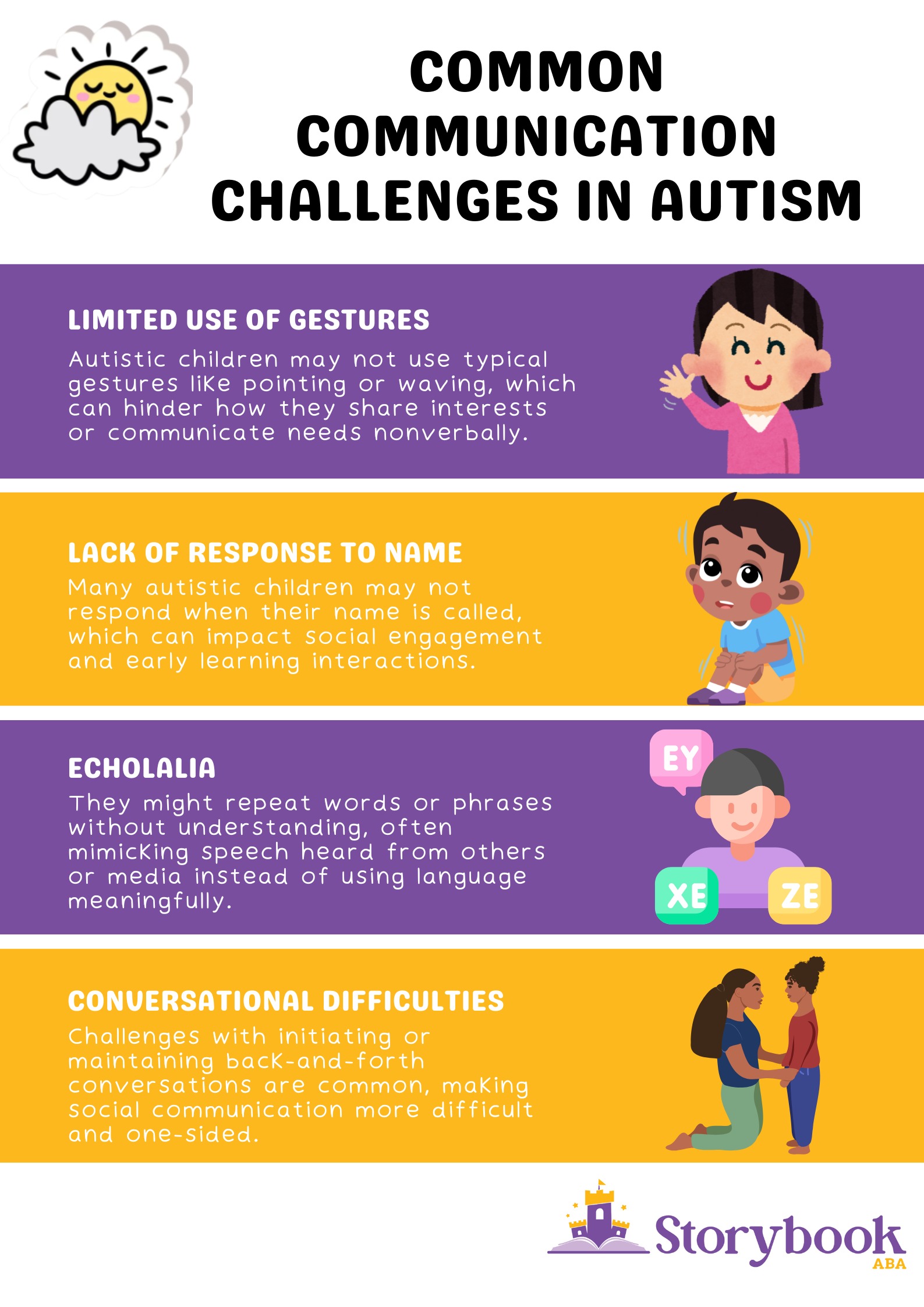
These patterns reflect core differences in how autistic children process language and social information, making communication more than just a verbal challenge.
How Can You Tell If It’s Just a Speech Delay?
Distinguishing between a speech delay and autism involves looking beyond when a child starts talking to how they communicate and interact socially. A child with a speech delay may struggle to form words or sentences but typically uses gestures, responds to their name, and shows interest in social interactions.
In contrast, children with autism often have broader communication challenges. These may include limited eye contact, lack of joint attention, reduced use of gestures, and difficulty with back-and-forth interaction.
If a child shows speech delays along with social and behavioral differences, it may indicate autism rather than a simple delay. Early evaluation by a specialist is key for an accurate diagnosis. For families navigating these early signs, building strong support at home through guidance and education is just as essential—learn more in our article, Parent Training for Autism: Effective Strategies and Tips.
Can a Child Have Both Speech Delay and Autism?
Yes, many autistic children experience both. In fact, delayed or atypical speech development is one of the earliest red flags that prompts further evaluation for autism.
Key overlapping features might include:
- Delayed expressive and receptive language.
- Limited vocabulary growth.
- Difficulty using language for social interaction.
- Unusual tone, pitch, or rhythm in speech.
However, it’s important to note that not all children with speech delays have autism, and not all autistic children have language delays. An evaluation by a developmental specialist can clarify the difference.
When Should You Seek Professional Evaluation?
If your child shows signs beyond speech delays—such as social withdrawal, repetitive behavior, or sensory sensitivities—it’s important to seek a developmental evaluation. Early diagnosis can lead to earlier interventions and better outcomes.
Parents should consider an evaluation if:
- By 12 months, the child isn’t babbling or using gestures.
- By 16 months, they don’t say single words.
- By 24 months, they don’t use simple two-word phrases.
- They don’t respond to their name by 12 months.
- There’s a sudden loss of speech or social skills.
A comprehensive assessment can determine whether the delay is part of a broader developmental difference, such as autism. If you’re navigating similar concerns and want a clearer understanding of what this might look like in everyday life, we recommend exploring our article A Parent’s Guide to High-Functioning Autism.

What Are the Treatment Options?
Treatment depends on the diagnosis. Children with isolated speech delays typically benefit from speech-language therapy. If autism is diagnosed, a more holistic approach—such as Applied Behavior Analysis (ABA)—may be recommended.
Key therapies include:
1. Speech-Language Therapy
This therapy targets speech, language, and communication skills. It helps children improve articulation, vocabulary, and sentence structure, and is especially effective for isolated speech delays.
2. ABA Therapy
Applied Behavior Analysis (ABA) uses structured techniques to teach communication, social, and daily living skills. It’s a widely recommended, evidence-based therapy for children diagnosed with autism.
3. Occupational Therapy
Occupational therapy supports children in developing fine motor skills, sensory processing, and daily routines, helping them become more independent and function better in everyday environments.
4. Parent Training and Support
Training empowers parents with tools to reinforce therapy goals at home. It builds consistency, boosts confidence, and helps families respond effectively to their child’s unique needs.
Early, individualized treatment gives children the best chance for progress, regardless of diagnosis.
How Can Parents Support Their Child at Home?
Whether your child has a speech delay or autism, your support matters. Creating a language-rich environment and being responsive to their communication attempts can make a big difference.
Support strategies include:
1. Narrate Everyday Activities
Talk through daily routines like dressing or eating to expose your child to consistent language. This builds vocabulary and helps them connect words with actions and objects.
2. Read Picture Books Together
Reading books aloud supports language development. Ask open-ended questions and point to images to encourage engagement, comprehension, and conversational turn-taking.
3. Encourage Communication Through Play
Play activities like pretend cooking or puppet shows create natural opportunities to use language, make choices, and practice social interaction strategies in a fun, low-pressure setting.
4. Use Visual Supports
Incorporate picture cards, schedules, or gesture cues to support understanding. Visuals can reduce frustration and make routines easier to follow for children with communication challenges.
5. Model Simple, Clear Language
Use short, repetitive phrases to model how language works. Repeating words and phrases in context helps your child learn by example and boosts their confidence to speak.
Consistency and patience are key. Celebrate small wins and keep reinforcing communication in meaningful ways.
Promote Positive Change With ABA Therapy
At Storybook ABA, we understand that distinguishing between speech delay and autism can be confusing and emotional. Our team specializes in Applied Behavior Analysis (ABA) therapy to support children with autism in developing communication, behavioral, and social skills.
We offer ABA therapy in Maryland and Virginia that’s personalized, evidence-based, and focused on empowering both children and families. We partner with parents to build daily routines, enhance communication, and support long-term development.
Reach out to us to schedule a consultation and take the first step toward clearer communication and meaningful progress with your child!